Highly Reproducible, Vendor-Agnostic, Motion-Insensitive Liver PDFF Mapping
A new paper from Jiayi Tang et al describes a free-breathing MRI-based liver fat quantification method that works equivalently across systems of different MRI manufacturers. This addresses two limitations of currently available MRI-based fat quantification methods, namely motion sensitivity, which requires breath holding and lowers feasibility in patients such as children and the infirm; and variability between systems, due to each manufacturer implementing their own methods. The method was validated in both adults and children, and demonstrated superior image quality, high accuracy, and improved precision and reproducibility across systems compared to conventional methods. This may lead to more accessible and feasible liver fat quantification for patients of all ages and at more imaging centers.
 Tang J, Tamada D, Nielsen JF, Starekova J, Heidenreich JF, Schön F, Anagnostopoulos AA, Roshanshad A, Mao L, Fujita S, Xu P, Keen C, Shaik IA, Milshteyn E, Yee S, Ellison AJ, Rutkowski D, Kammerman J, Brittain JH, Zhong X, Grissom WA, Zaitsev M, Carrel AL, Rathi Y, Jiang Y, Bilgic B, Reeder SB, Hernando D. Highly Reproducible, Vendor-Agnostic, Motion-Insensitive Liver PDFF Mapping at 0.55T, 1.5T, and 3T. Magn Reson Med. 2025 Dec 12. PMID: 41387985.
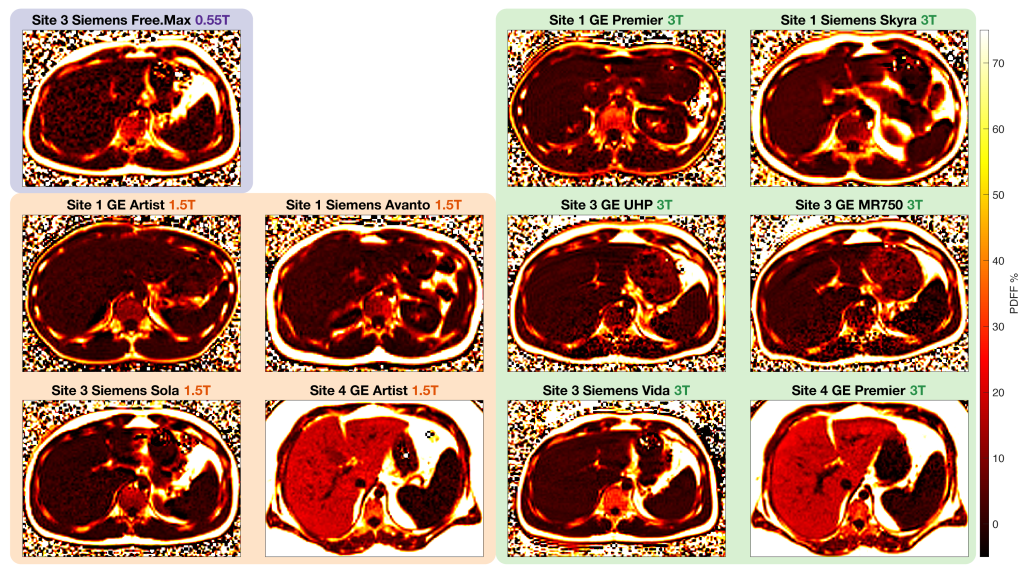
Pulseq-FAM enables free-breathing in vivo liver PDFF mapping with high image quality, regardless of vendor, MR system, and field strength. The figure shows example free-breathing liver PDFF maps acquired with Pulseq-FAM, of different volunteers with varying levels of liver fat, for each MR system in this study where in vivo imaging was possible. Pulseq-FAM demonstrates free-breathing in vivo feasibility with high apparent image quality in all hardware and site settings, although minor artifacts are visible on some 3T systems (arrows), and the 0.55T system shows lower apparent SNR.