New work demonstrates explanted liver model for validating quantitative MRI method
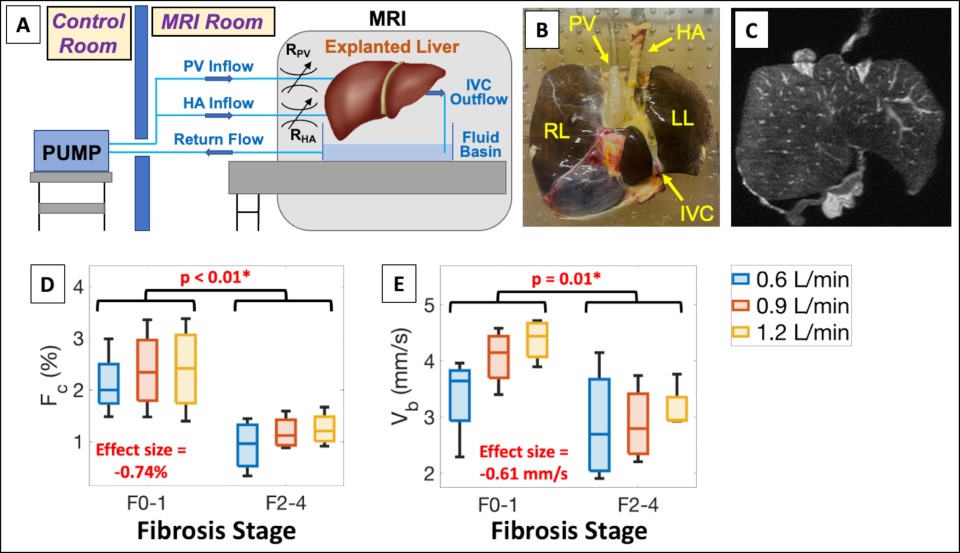
A new paper from Simchick et al. has demonstrated the feasibility of using perfused explanted human livers for validatinga quantitative MRI-based technique which evaluates tissue microstructure and microvascular flow (i.e., intravoxel incoherent motion (IVIM) MRI). Explanted livers from deceased donors were connected to a perfusion system via the portal vein and hepatic artery, and MRI was performed under various highly controlled flow conditions.Using this perfused explanted liver system, the authors were able to detect differences between livers with no-to-mild fibrosis (stages F0-1) and moderate-to-advanced fibrosis (stages F2-4).Importantly, MRI-based evaluation of liver organ condition using perfused explanted liver systems may improve transplantation success rates, enabling efficient and life-saving workflows in transplantation clinics.
(A) Experimental MRI setup consisting of dual inflow lines for the portal vein (PV) and hepatic artery (HA). Using a peristaltic pump, organ preservation solution with constant, non-pulsatile flow was perfused through an explanted liver. Each inflow line included a resistive valve (R) to constrain the inflow ratio of the PV vs HA. The inferior vena cava (IVC) was cannulated to facilitate extraction of the mixed outlet flow, which was collected in a fluid basin for return flow to the pump. (B) Image of explanted liver and flow connections. Abbreviations: RL, right lobe; LL, left lobe. (C) T2-weighted MR image of explanted liver. (D and E) Boxplots of MRI-derived relaxation-corrected perfusion signal fraction (Fc) and blood velocity standard deviation (Vb) for explanted livers with fibrosis stages F0-1 and F2-4 perfused with various total volumetric flow rates.
Simchick G, Rice J, Gober LM, Rice D, Philip J, Roldan-Alzate A, Hernando D. Validation of Intravoxel Incoherent Motion MRI Using Perfused Explanted Human Livers. Magn Reson Med. 2025 Nov 14. doi: 10.1002/mrm.70184. Epub ahead of print. PMID: 41235815.